Parts · v0.7.0
realtime
Channels over WebSocket (offrails.v1) with SSE and long-poll fallbacks: typed rooms, topic authorization on every join and push, presence across tabs and nodes, resume after reconnect, signed socket tokens, revocation, per-user caps, tuned buffers, a live room demo and /dev/sockets
- Add it
cargo offrails add realtime- Requires
- nothing
- Crates
axum --features ws,hmac,--dev tokio-tungstenite- Files
44 files at app paths, 42 wiring lines
migration/src/m20261016_005000_create_guests.rsmigration/src/m20261016_005100_create_rooms.rsmigration/src/m20261016_005200_create_realtime_token_uses.rssrc/channels/accounts.rssrc/channels/identity.rssrc/channels/live_room.rssrc/channels/mod.rssrc/controllers/live.rssrc/kernel/channels.rssrc/kernel/cluster.rssrc/kernel/hub.rssrc/kernel/socket_token.rssrc/kernel/sockets_web.rssrc/kernel/transports.rssrc/models/guest.rssrc/models/guest_session.rssrc/models/room.rssrc/models/room_message.rssrc/views/live.rsstatic/channels.jsstatic/kernel/sockets.cssstatic/live_room.jstemplates/kernel/sockets/_live.htmltemplates/kernel/sockets/index.htmltemplates/live/_header.htmltemplates/live/_message.htmltemplates/live/_palette.htmltemplates/live/show.htmltemplates/live/sign_in.htmltests/app/realtime_test/accounts.rstests/app/realtime_test/client.rstests/app/realtime_test/cluster.rstests/app/realtime_test/live_room.rstests/app/realtime_test/mod.rstests/app/realtime_test/people.rstests/app/realtime_test/people_accounts.rstests/app/realtime_test/presence.rstests/app/realtime_test/protocol.rstests/app/realtime_test/resume.rstests/app/realtime_test/security.rstests/app/realtime_test/tokens.rstests/app/realtime_test/transports.rstests/e2e/live.scenario.mjstests/e2e/live_room.e2e.mjs

.offrails/template/parts/realtime/README.md
realtime
Channels for a Rust off Rails app: one connection per tab speaking offrails.v1 over a WebSocket, falling back by itself to Server-Sent Events + POST and then long polling when a proxy breaks WebSockets. Typed rooms (Room: joined, handle_in, handle_out), topics authorized on every join and every push, presence that lists people (not tabs) across tabs, devices and nodes, resume after a reconnect from a durable cursor, and a session that is checked for the connection's whole life. It's what Phoenix Channels + Presence and Action Cable give you, with the security rules written down and tested, and no Redis: more than one node talks over Postgres LISTEN/NOTIFY.
- Protocol: typed JSON frames (
join,leave,push,pingup;ok,err,event,presence,pong,slow,byedown), refs echoed in replies, heartbeats both ways,seqcursors and replay after a reconnect, agapwhen too much was missed, stable error codes and close codes. - Transports: WebSocket first; SSE + POST, then long polling, picked by
static/channels.js(no framework) when one is blocked; it remembers what worked in the tab and probes back to the WebSocket every minute. WebSocket buffers tuned for 10,000 sockets on one box (4 KiB reads, no write staging, a 256 KiB backpressure cap). - Who's connecting: the session cookie with an exact
Origincheck (cross-site WebSocket hijacking), or a 60-second, single-use, HMAC-signed socket token (offered as a subprotocol, never in the URL) for clients on another origin or no browser at all. The person always comes from the server's session, never from a frame. - Authorization:
Channels::authorizedecides every topic, deny by default, against the database at every join, every push, every revalidation and onHub::reauthorize(someone removed from a room leaves it at once, on every node). A members-only room and a missing one give the same answer. - Revocation: signing out closes that session's sockets and streams (
bye revoked, 4401) on every node and leaves the person's other devices alone; an expired session is closed by the next revalidation (60 s). - Limits: 128 connections per person (sized for tabs; checked and counted under one lock), 20 topics and 30 joins a minute per connection, 100 frames per 10 s, 4 KiB per frame, 10 messages per 10 s per person per room, slow consumers warned then dropped, a write stalled for 10 s ends the connection.
- Presence: CRDT-free and correct across tabs, devices and nodes: each node is the only writer of its own refs and publishes them in order; a new node asks for everyone's refs; a silent node's people leave after 6 s, a cleanly stopped one's at once. Minimal metadata (a name, initials, a color), never an email.
- Server API:
hub.broadcast,broadcast_from(everyone but the sender),emit(typed),reauthorize,revoke; in a room,out.emit(durable),emit_ephemeral,broadcast_from,emit_to(another topic);channels::refresh(topic, region)makes every open page re-fetch an htmx region. - Demo: a two-pane live room at
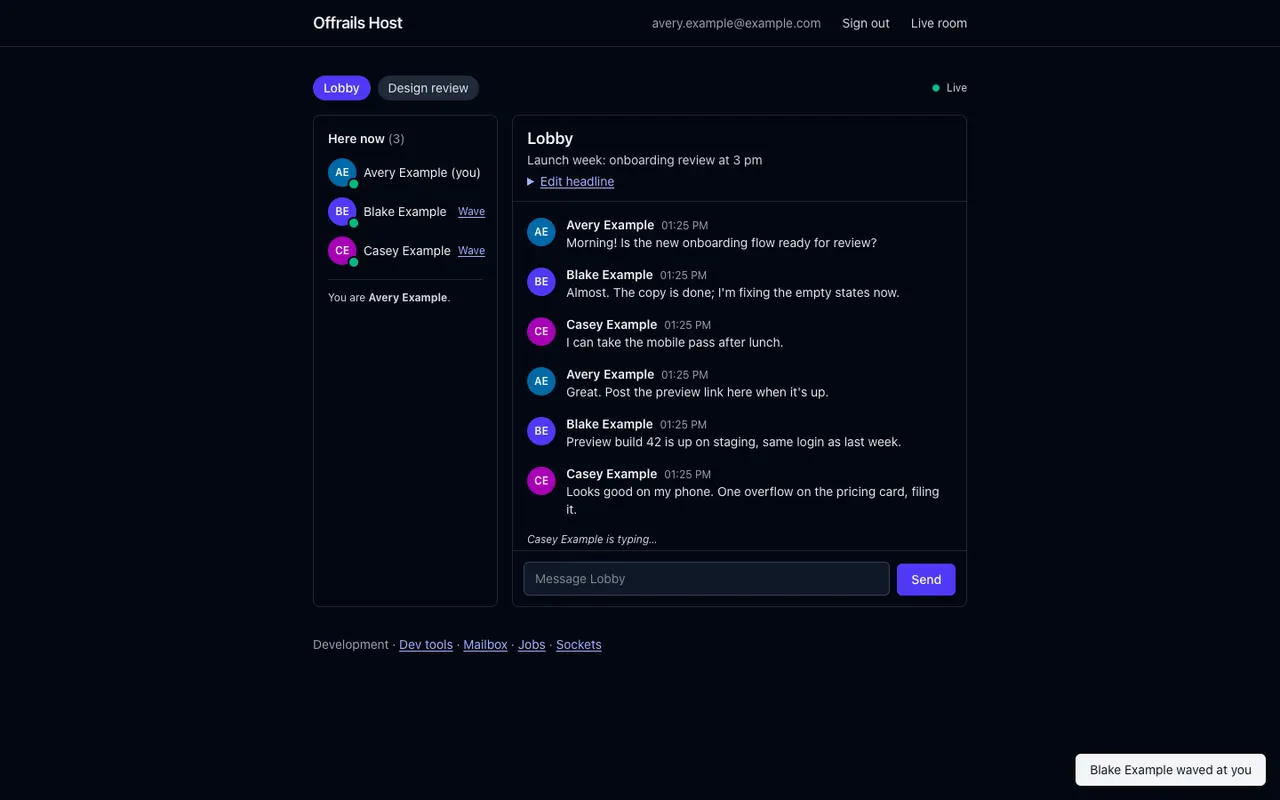
/live/<room>: who's here with avatars and a wave button, messages, "is typing…", an htmx header refreshed on every page when someone edits it. Development guests sign in with a display name, so it runs on a blank app. /dev/sockets: this node and the cluster, every topic with who is present, every connection with its transport and frame counts, frame rates, room restarts, and a live decoded frame log per connection.
Extracted from Rust off Rails apps and rebuilt. Fixed on the way: a per-user cap of 8 that locked people out at about five tabs; a cap check and the count that followed it under two locks (concurrent connects overshot); one forwarder task and channel per joined topic (the connection task reads its receivers itself now); a logout that slipped between the handshake and the connection's start; relays bound to the person but not the session; an unknown relay id answering differently from someone else's. Added: rooms with typed pushes in the same hub as presence, SSE and long-poll fallbacks around the tuned WebSocket loop, handle_out, broadcast_from, socket tokens, cluster presence without an owner node, /dev/sockets, and the htmx refresh helper.
Guides: .offrails/guides/channels.md · .offrails/guides/realtime.md · .offrails/guides/security.md#websockets. Depends on: nothing (it ships development guests). With auth-core installed too, before or after, people are accounts instead: optional wiring does it ("Use your accounts" below).
Screens
Every screen in light and dark, on desktop and phone: the samples repository.
Install
By hand, in the app root:
- Crates, with
cargo add(never a version):cargo add axum --features ws,cargo add hmac,cargo add --dev tokio-tungstenite. - Copy
files/into the app, keeping the paths. In the tests and thefactories.rswiring, replaceoffrails_hostwith your crate name. - Wiring (each at its
samples: <anchor>comment when the app has one; otherwise at the spot described). The exact text of each is insample.toml:src/lib.rs:pub mod channels;.src/kernel/mod.rs:pub mod channels; pub mod cluster; pub mod hub; pub mod socket_token; pub mod sockets_web; pub mod transports;.src/kernel/ui.rs: aTab { key: "sockets", label: "Sockets", href: "/dev/sockets", dev_only: true }in the kernel header'sTABS.src/models/mod.rs:pub mod guest; pub mod guest_session; pub mod room; pub mod room_message;.src/controllers/mod.rs:pub mod live;.src/views/mod.rs:pub mod live;.src/config.rs: arealtime: RealtimeConfigfield, itsDebugline,let realtime = RealtimeConfig::parse(&get, &mut invalid, env, &database_url);next to the other parsing,realtime,inOk(Self { … }),realtime: RealtimeConfig::test(),inConfig::test(), and theRealtimeConfigstruct afterimpl Config.src/state.rs:pub hub: crate::kernel::hub::Hub<crate::channels::AppRoom>, built withlet hub = crate::channels::build_hub(&config, &db)?;beforeOk(Self { … }).src/routes.rs:app = app.merge(crate::channels::router()).merge(crate::controllers::live::router());with the other routes; insideif config.is_development() { … },app = app.merge(crate::controllers::live::dev_router()).merge(crate::kernel::sockets_web::router());;paths::live()andpaths::dev_sockets(); the seventeenROUTESrows.src/controllers/dev.rs: the Sockets and Live room tiles, and two system facts.src/kernel/introspect.rs:out["realtime"].src/main.rs, inserve:state.hub.start().await?; let realtime_hub = state.hub.clone();after the router is built, andrealtime_hub.close();in the shutdown future, before the drain starts.migration/src/lib.rs: the threem20261016_0050…migrations (modlines andBox::new(…)entries).templates/shared/_nav.html: a "Live room" link;templates/layouts/application.html: a "Sockets" link in the development footer,hx-boost="false"(a kernel page, in its own layout).src/views/mod.rs: twoCtxfields,channels_jsandlive_room_js(digested URLs);src/controllers/application.rsfills them;templates/layouts/application.html: both<script … defer>tags atsamples: app head, so every app page loads them. Never in the room's{% block head %}: links are boosted, and a boosted click runs nothing in the next page's<head>.live_room.jsstarts a[data-live-room]onhtmx:loadand leaves its topics before a boosted swap removes it.tests/app/main.rs:mod realtime_test;;tests/app/factories.rs:find_room;tests/app/security_test.rs:src/channels/mod.rs,src/controllers/live.rsandsrc/kernel/sockets_web.rsin the route sources;tests/app/kernel_web_test.rs: the three/dev/socketspaths in the no-store list;tests/app/theme_switch_test.rs:"/dev/sockets"inKERNEL_PAGES..env.example: the sixAPP_REALTIME_*,APP_CLUSTERandAPP_NODElines.- Anchors of its own, for the optional wiring:
// samples: channel mods(src/channels/mod.rs),// samples: identity source(src/channels/identity.rs),// samples: realtime test modsand// samples: realtime people(tests/app/realtime_test/). They ship infiles/. - With auth-core installed (the
when = "auth-core"wires;install.shapplies them whichever of the two comes first):pub mod accounts;insrc/channels/mod.rs;pub use crate::channels::accounts::{DEV_GUESTS, by_session, current, session_live};above the guests' glob inidentity.rs;crate::channels::session_ended(state, user_id);in auth-core'sauth::sessions_ended;mod accounts; mod people_accounts;intests/app/realtime_test/mod.rs, and theirpub useinpeople.rs.
cargo fmt --all && cargo run -- routes(rewritesdocs/routes.md),bin/tailwindcss -i assets/app.css -o static/app.css, then the Definition of Done.
tools/install.sh realtime <app> does steps 1 to 3.
After installing
- Accounts: alone, the sample signs people in as development guests (
/dev/guests/sign-in, development only), and in production nobody is signed in, so every socket answers 401. With auth-core, people are accounts already ("Use your accounts" below); with another auth system, adaptidentity.rsthe same way before shipping. - Deploy config:
APP_REALTIME_SECRET(32+ random characters) if any client uses socket tokens;APP_CLUSTER=truewhen more than one node serves sockets (Postgres only); behind a proxy that breaks WebSockets,APP_REALTIME_TRANSPORTS=sse,longpoll. Serve over HTTP/2 (TLS): over HTTP/1.1 a browser holds about six connections per origin, and the fallbacks hold one each (realtime). docs/decisions.md: note that channels replay from the database (no owner node), that per-room rate limits are per node, and which transports you offer.AGENTS.md: nothing changes in the header; mention/dev/socketsandtests/e2e/live.scenario.mjswhere you list the app's tools.- Try it:
bin/dev, open/livein a browser and in a private window, sign in as two people, talk; open/dev/socketsin a third tab. In a real browser:BASE=… node tests/e2e/live_room.e2e.mjs(two people, typing, a wave, both fallbacks, sign-out) andSCENARIO=tests/e2e/live.scenario.mjs BASE=… TABS=40 bash .offrails/tools/browser-smoke/run.sh live-tabs.
Adapting it
- Use your accounts (auth-core): install auth-core (before or after this sample) and the optional wiring does the rest:
src/channels/accounts.rsbecomes part of the build andidentity.rsre-exports it over the guests, socurrentreads auth-core's session cookie,by_sessionandsession_livecheck auth-core'ssessions(idle and absolute expiry included), and auth-core'sauth::sessions_ended(called after every sign-out, sign-in over another session, revoked device, "sign out everywhere", password change and reset, "this wasn't me") closes that person's sockets at once. The live room then sends signed-out people to/session/new, and the guest pages redirect there. Presence shows a neutral "Member 42", never the address nor a name guessed from it (an address's local part is often a full name or worse):accounts::display_name(// APP:) is the place for your own name column, once people choose a name. The whole realtime suite runs against accounts (tests/app/realtime_test/people_accounts.rs), plusaccounts.rsfor sign-out and the guest pages. Once nobody uses guests, deletemodels/guest.rs,models/guest_session.rs, theguestsmodule inidentity.rs, thedev_routerincontrollers/live.rsandpeople.rs'sguestsmodule; the guest migration stays (append-only) and its tables stay empty. - Another auth system: write
src/channels/<yours>.rslikeaccounts.rs(the same four items:current,by_session,session_live,DEV_GUESTS) and addpub use crate::channels::<yours>::{DEV_GUESTS, by_session, current, session_live};above the guests' glob inidentity.rs. Callcrate::channels::session_ended(&state, user.id)after every place a session ends. - A per-board channel (or a document, a match): copy
src/channels/live_room.rstoboard_room.rswith its ownIn/Outenums, add a variant toAppRoom(theinitdispatch by topic prefix), and an arm toauthorizeinsrc/channels/mod.rs:Some(("board", id)) => boards::authorize(self, member, id).await. For a board many people watch, carry the state itself (the join'sok.datais the snapshot plus itsseq; patches carry final state through one reducer; actions stay HTTP POSTs that write an event row and broadcast after the commit): channels, "Live boards over a channel". - Only members can join: the
backstageroom shows it.room::admitschecksroom_membersagainst the database on every join and push; afterroom::remove_member, calls.hub.reauthorize(&room::topic(slug))and every connection of that person, on every node, leaves the room at once (reauthorize_removes_a_member_who_lost_access_at_once). - Add a typing indicator (or cursors, "is viewing"): an
Invariant with no payload, answered without.broadcast_from(Out::Typing { … })(everyone but the sending connection) and filtered inhandle_outfor the typist's other tabs; throttle it in the room (Pace) and in the client (TYPING_EVERYinstatic/live_room.js). Ephemeral events have noseqand are never replayed. - Scale to many nodes:
APP_CLUSTER=true(Postgres): each node joinsLISTEN offrails_realtimeand shares broadcasts, presence, revocations and re-authorizations; a load balancer needs no sticky sessions (clients resume from their cursor on any node). Each node keeps its own per-person cap (max_conns_per_user,// APP:inkernel/channels.rs) and per-room rate limits. Beyond a few thousand cluster messages a second,NOTIFYis the bottleneck: the escape hatch is a node-to-node mesh, recorded indocs/decisions.md. - Clients on another origin (a native app, a SPA elsewhere): set
APP_REALTIME_SECRETandAPP_REALTIME_ORIGINS; the client gets a token fromPOST /socket/token(or your API mints one withkernel::socket_token::mintafter its own authentication) and opensnew WebSocket(url, ["offrails.v1", "offrails.token." + token])within 60 s. The token works once and dies with its session.
Do not change
- Every join, push, revalidation and
reauthorizegoes throughChannels::authorize, and unknown topics are refused (joining_someone_elses_topic_is_forbidden,unknown_topics_are_refused_by_default,a_push_after_losing_access_is_forbidden_and_leaves). - A cookie handshake needs APP_URL's exact
Origin, a missing one included (a_foreign_or_missing_origin_is_refused_at_the_handshake); relays refuse cross-site GETs and POSTs (cross_site_requests_are_refused_on_every_transport). - The person comes from the session, never from a frame: pushes are
deny_unknown_fields(a_push_cannot_post_as_someone_else). - Revocation is keyed by person and each connection re-checks its own session (
logout_closes_that_sessions_sockets_only,an_expired_session_is_closed_by_revalidation);runsubscribes before it checks the session once more. - Subscribe before computing a join's reply; store before emitting (
a_reconnect_replays_exactly_what_was_missed,a_message_is_stored_before_anyone_sees_it). - Relays are bound to person, session and a 256-bit token compared in constant time (
relays_need_their_owner_session_and_token). - The buffer sizes in
kernel::channels::upgradeandTOPIC_BUFFER; the caps inSocketConfig::new(the_connection_cap_refuses_the_next_socket_with_1008,flooding_closes_the_socket_with_1008,an_oversized_frame_closes_the_socket); writes are bounded bysend_timeout(a_client_that_stops_reading_is_dropped). - Socket tokens: signature first, short-lived, single use, bound to the session (
a_socket_token_works_once,a_forged_or_altered_socket_token_is_refused,an_expired_socket_token_is_refused). /dev/socketsand the guests are development only; the frame log is off elsewhere (development_guests_and_dev_sockets_do_not_exist_in_production_or_test,the_frame_log_is_off_outside_development).- Text people typed is rendered with
textContentinstatic/live_room.jsand escaped by Askama on the page (html_in_messages_is_delivered_raw_and_rendered_escaped).
How it works
browser tab ── WebSocket /socket (offrails.v1) ──▶ kernel/channels.rs  run(): one task per connection
          └─ or SSE /socket/sse + POST ───────────▶ kernel/transports.rs relays around the same run()
          └─ or long poll /socket/poll ───────────▶
                                       │ join / push (authorized by src/channels/mod.rs)
                                       ▼
                                 kernel/hub.rs  Hub<AppRoom>: a broadcast sender per topic,
                                 presence by person, a room actor per topic, revocations by person
                                       │ store first                    │ other nodes
                                       ▼                                ▼
                                 room_messages (seq = id)       kernel/cluster.rs: pg_notify / LISTEN
A room (src/channels/live_room.rs) is a tokio task per topic that runs one command at a time under supervision: a panic answers unavailable, counts a restart and rebuilds the state. A push is deserialized into the room's In enum before the room sees it (anything else is bad_event); what the room emits is serialized once and shared by every subscriber, except the events it intercepts (handle_out). Durable events carry seq, the message's row id; a client rejoins with since and gets exactly what it missed, from the database, so any node can answer (the guide's owner-node design isn't needed when replays read the database; per-room rate limits are therefore per node). Presence refs are (node, connection): a person joins with their first ref and leaves with their last.
One connection, any transport. kernel/channels.rs::run is the whole protocol: limits, authorization, the join sequence (ok, the replay, here, then live diffs), heartbeats (WebSocket pings every 20 s; the client asks with ping after 25 s of silence), revalidation every 60 s, revocation, resync and shutdown. The WebSocket and both relays are Pipes around it. static/channels.js tries the transport that worked last in the tab, moves on when one doesn't open within 5 s, reconnects with jittered backoff (250 ms → 10 s, ±25%), rejoins every channel with its cursor, buffers presence diffs until the new snapshot, drops events at or below its cursor, stops on bye revoked and fires offrails:revoked.
More than one node (kernel/cluster.rs, APP_CLUSTER=true). Each node publishes, from one task and in order, what its own connections do: Fanout, Track/Untrack, Revoke, Reauthorize, plus Heartbeat every 2 s and Bye on shutdown. A new node says Hello, every node answers with a complete Sync of its refs (chunked under the 8,000-byte NOTIFY limit), which replaces what the others knew about it. A node silent for 6 s is dead: its people leave. A lost LISTEN connection means lost messages: the node asks for fresh syncs and closes its sockets with 1012, so clients resume from their cursors. On SQLite the same messages travel an in-process bus (LocalBus), which is how the multi-node tests run on both databases.
| Route | Does |
|---|---|
GET /socket | the WebSocket (offrails.v1); a socket token as a second subprotocol |
GET /socket/sse, POST /socket/sse/{id} | the SSE relay: hello {conn, token}, then one frame event per frame; frames go up by POST with x-offrails-token |
POST /socket/poll, GET/POST /socket/poll/{id} | the long-poll relay: {conn, token}; GET waits ≤ 25 s and returns a JSON array |
POST /socket/token | {token, expires_in, protocol} for this session (60 s, single use); 404 without APP_REALTIME_SECRET |
GET /live, /live/{name} | the live room (redirects to sign in when signed out) |
GET /live/{name}/header, POST /live/{name}/headline | the header region, and the edit that refreshes it on every open page |
GET/POST /dev/guests/sign-in, POST /dev/guests/sign-out | development guests |
GET /dev/sockets, /dev/sockets/live, /dev/sockets.json | the dev panel, its live part, and the same as JSON for agents |
Close codes: 1001 idle · 1002 protocol (also: no offrails.v1) · 1003 binary · 1008 rate limited or over the connection cap · 1009 frame too large · 1012 restart (reconnect, maybe elsewhere) · 1013 too slow · 4401 session revoked or expired (don't reconnect). err codes: forbidden, unknown_topic, not_joined, already_joined, invalid, rate_limited, bad_event, limit, unavailable.
Files
| File | What |
|---|---|
src/kernel/hub.rs | the hub: Room, Outbox, topics, presence, room actors, revocations, caps, frame log, snapshot |
src/kernel/channels.rs | offrails.v1: typed frames, Channels, SocketConfig, the connection loop, the WebSocket transport, origin rules |
src/kernel/transports.rs | the SSE and long-poll relays |
src/kernel/cluster.rs | the bus between nodes: Postgres LISTEN/NOTIFY or in-process |
src/kernel/socket_token.rs | signed, single-use socket tokens |
src/kernel/sockets_web.rs | /dev/sockets |
src/channels/mod.rs | the app's side: routes, authorize, build_hub, session_ended, refresh |
src/channels/live_room.rs | the example room (AppRoom, LiveRoom) |
src/channels/identity.rs | who is connecting: the people source (development guests, or accounts re-exported over them) |
src/channels/accounts.rs | people as auth-core accounts; built only when auth-core is installed (optional wiring) |
src/controllers/live.rs, src/views/live.rs | the live room's pages and the development sign-in |
src/models/{guest,guest_session,room,room_message}.rs | guests, rooms and members, messages |
migration/src/m20261016_0050{00,100,200}_*.rs | guests, rooms (seeded: lobby, design, backstage), socket token uses |
templates/live/*.html, templates/kernel/sockets/*.html | the pages |
static/channels.js | the client: connection, transports, channels, presence, refresh |
static/live_room.js, static/kernel/sockets.css | the live room's behavior; the dev panel's styles |
tests/app/realtime_test/ | the tests named in CHECKS.md (protocol, security, tokens, presence, resume, transports, cluster, pages); people.rs signs people in (guests, or people_accounts.rs with auth-core), accounts.rs runs with auth-core only |
tests/e2e/live_room.e2e.mjs, tests/e2e/live.scenario.mjs | the two-person browser test; the scenario for the framework's live-tabs and a11y smokes |